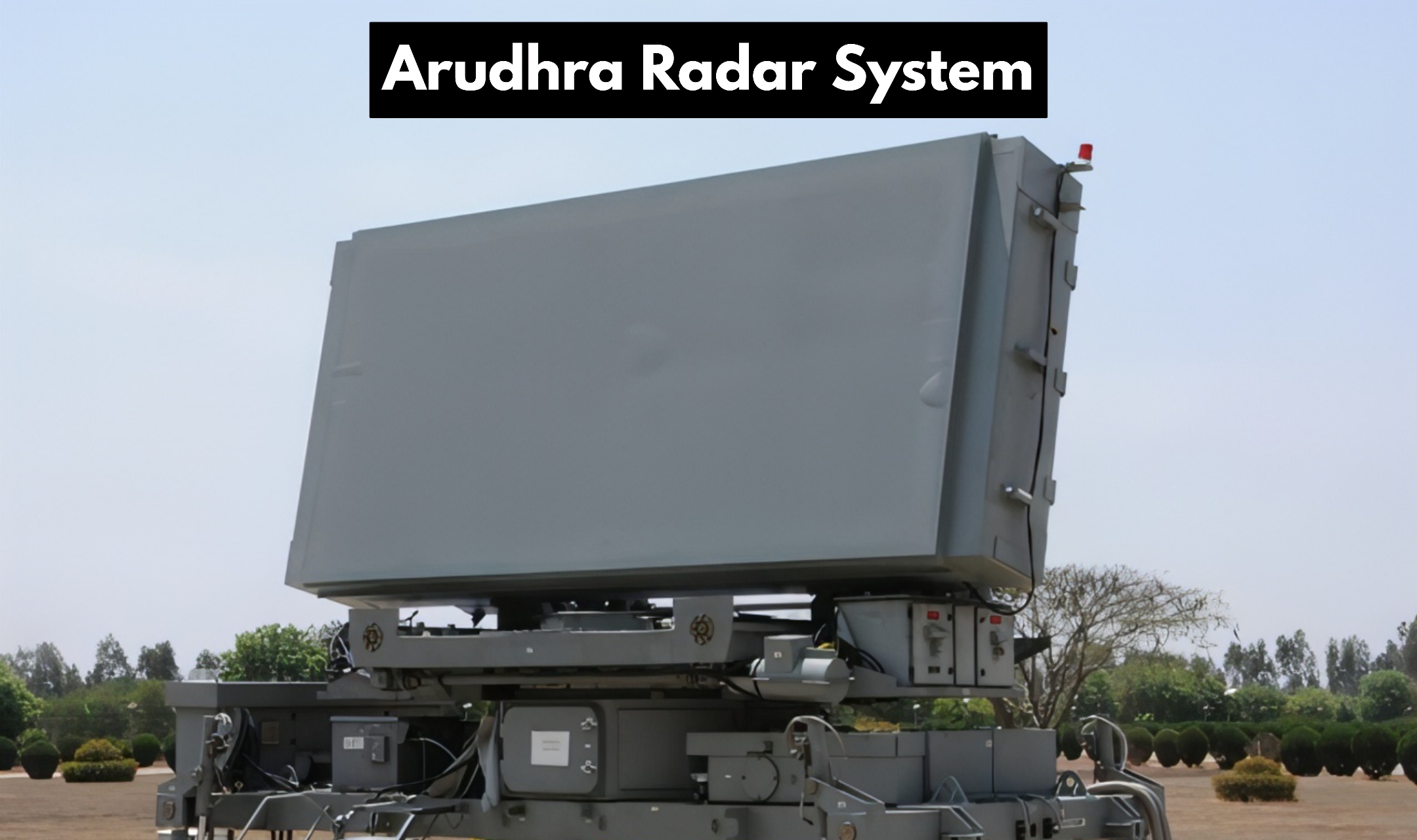
India’s air defence capabilities have received a significant boost with the Arudhra Medium Power Radar, an advanced indigenous system developed by the Defence Research and Development Organisation (DRDO) and manufactured by Bharat Electronics Limited (BEL). As tensions in the region underscore the need for robust surveillance, Arudhra stands out for its potential to detect and track modern low-observable aircraft, including simulated engagements against platforms like F 35 stealth aircrafts.
Cutting Edge Technology and Design
Arudhra is a 4D Active Electronically Scanned Array (AESA) radar operating in the S-band. It features electronic beam steering in both azimuth and elevation, enabling rapid, flexible scanning without mechanical limitations in staring mode (±60° azimuth) while offering full 360° coverage in rotating mode at 7.5 or 15 rpm.
Key specifications include an instrumented range of up to 400 km and a detection range of approximately 300 km against a 2 m² Radar Cross Section (RCS) target. It covers altitudes from 100 meters to 30 km and can automatically detect, track, and classify hundreds of aerial targets — from fighter jets and helicopters to cruise missiles, ballistic missiles, and drones. Integrated Identification Friend or Foe (IFF) enhances target discrimination in contested environments.
Its solid-state design, advanced signal processing, and electronic counter-countermeasure (ECCM) features make it resilient against jamming and electronic warfare, allowing reliable operation in all weather conditions.
Range And Capabilities Against Conventional & Stealth Aircrafts
While official figures focus on conventional targets, Arudhra’s capabilities against stealth platforms have drawn considerable attention. Radar detection range scales with the fourth root of the target’s RCS, meaning performance drops more gradually than the reduction in visibility might suggest.
Recent AI-assisted simulations reportedly demonstrated the radar successfully tracking a virtual F-35A stealth fighter and relaying data into the Indian Air Force’s Integrated Air Command and Control System (IACCS). Estimates for very low-RCS targets (around 0.001 m², typical of optimized frontal aspects) suggest useful detection ranges could fall to tens of kilometres in ideal single-radar scenarios, though real-world networked performance benefits from multi-sensor fusion.
Arudhra is not a dedicated VHF anti-stealth radar but complements systems like the Surya VHF radar in a layered network. Its strengths lie in precision tracking, multi-target handling, and integration, which are critical for cueing air defence weapons against low-observable threats.
Arudhra offers robust detection capabilities against non-stealth aircraft, with an instrumented range of up to 400 km and a reliable detection range of approximately 300 km for targets with a 2 m² radar cross-section (RCS), typical of conventional fighter jets. It effectively monitors aerial threats from low-flying drones and cruise missiles at 100 metres altitude up to high-flying aircraft at 30 km, supporting automatic tracking of hundreds of targets in all-weather conditions.
Against stealth platforms like the F-35, which can present an extremely low frontal RCS of around 0.001 m², performance is governed by the radar range equation, where detection distance scales with the fourth root of the RCS. This results in significantly reduced but still tactically relevant ranges—potentially in the order of 50–100 km or more under optimal conditions in single-radar scenarios, with real-world effectiveness enhanced through network-centric integration in India’s IACCS and sensor fusion with other systems. Recent AI-assisted simulations have demonstrated Arudhra successfully tracking a virtual F-35 and feeding data for air defence coordination, underscoring its value in layered defences despite the inherent challenges posed by advanced low-observable technology.
Deployment and Strategic Role
A contract worth over ₹2,800 crore has facilitated the supply of multiple Arudhra units to the IAF, with several already inducted, including at forward bases like Air Force Station Naliya. Mountain-adapted variants are planned for high-altitude deployments in Jammu & Kashmir and the Northeast.
Arudhra replaces legacy systems such as the PSM-33, P-40, and TRS-2215, enhancing India’s transition to network-centric warfare. It strengthens early warning, airspace surveillance, and coordination with surface-to-air missiles, contributing to a multi-layered air defence shield.
Boosting Atmanirbhar Bharat :
The development of Arudhra underscores India’s push for self-reliance in critical defence technologies. Leveraging indigenous GaN-based components in related programmes, it positions India among a select group of nations with advanced AESA radar expertise.
As regional air power dynamics evolve, Arudhra represents a maturing capability that bolsters deterrence and operational readiness. Future upgrades and deeper integration with other indigenous sensors will further amplify its effectiveness in countering emerging aerial threats.