India may have operationally deployed nuclear warheads for the first time, according to SIPRI’s latest assessment. The move, potentially involving an Arihant class submarine , could mark one of the most significant shifts in India’s nuclear deterrence strategy in decades.

India’s Nuclear Posture Enters a New Phase
India has, for the first time, deployed 12 nuclear warheads during peacetime, according to the latest assessment released by the Stockholm International Peace Research Institute (SIPRI). The development marks a significant evolution in the country’s nuclear posture and is being closely watched by strategic analysts around the world.
For decades, India was widely believed to keep its nuclear warheads separate from missiles and delivery systems during peacetime. This approach aligned with its long-standing doctrine of “credible minimum deterrence” and the principle of No First Use (NFU). However, SIPRI’s Yearbook 2026 suggests that India may now be moving toward a more operationally ready nuclear deterrent.
According to the report, India currently possesses an estimated 190 nuclear warheads, an increase from approximately 180 warheads a year earlier. Of these, around 12 are now considered deployed with operational forces, representing a notable departure from previous assessments.
Why the Deployment Matters
The number itself may appear small compared with the massive nuclear stockpiles maintained by countries such as the United States and Russia. Yet experts say the significance lies not in the quantity, but in the shift in readiness.
Operational deployment generally means nuclear warheads are mated with their delivery systems or positioned in ways that allow quicker use if required. Analysts believe this could be linked to India’s expanding sea-based deterrent capabilities and the growing use of canisterised missile systems designed for rapid response.
SIPRI noted that India appears to be modernising its deterrence structure while continuing to develop long range delivery systems capable of reaching targets across Asia. The report also highlighted that regional security concerns involving both China and Pakistan continue to shape India’s strategic planning.
No Change in India’s Official Nuclear Doctrine
Despite the reported deployment, there has been no official indication that India intends to alter its stated nuclear doctrine.
India continues to maintain its No First Use policy, under which nuclear weapons would only be used in retaliation against a nuclear attack. The country’s broader strategy remains centred on maintaining a credible deterrent rather than pursuing an aggressive nuclear posture.
Security experts caution against interpreting the SIPRI assessment as evidence of a dramatic policy reversal. Instead, many view it as an adaptation to evolving geopolitical realities and advances in military technology.
Growing Regional Competition
The SIPRI report also underscores broader global trends. China continues to expand its nuclear arsenal at a rapid pace, while Pakistan is believed to be steadily modernising its own capabilities.
Against this backdrop, India’s latest deployment assessment reflects the increasingly complex security environment in Asia. Strategic planners argue that maintaining survivable and credible deterrence has become more important as regional military competition intensifies.
As governments worldwide reassess defence priorities amid rising geopolitical tensions, India’s reported deployment of 12 nuclear warheads represents more than a statistical update. It signals an important moment in the evolution of one of the world’s most closely watched nuclear doctrines.
Deployment Platform
Based on the latest SIPRI Yearbook 2026, the answer is: SIPRI does not identify the exact platform publicly. However, it strongly suggests that the 12 deployed warheads are most likely associated with India’s sea-based nuclear deterrent, specifically an SSBN (nuclear-powered ballistic missile submarine).
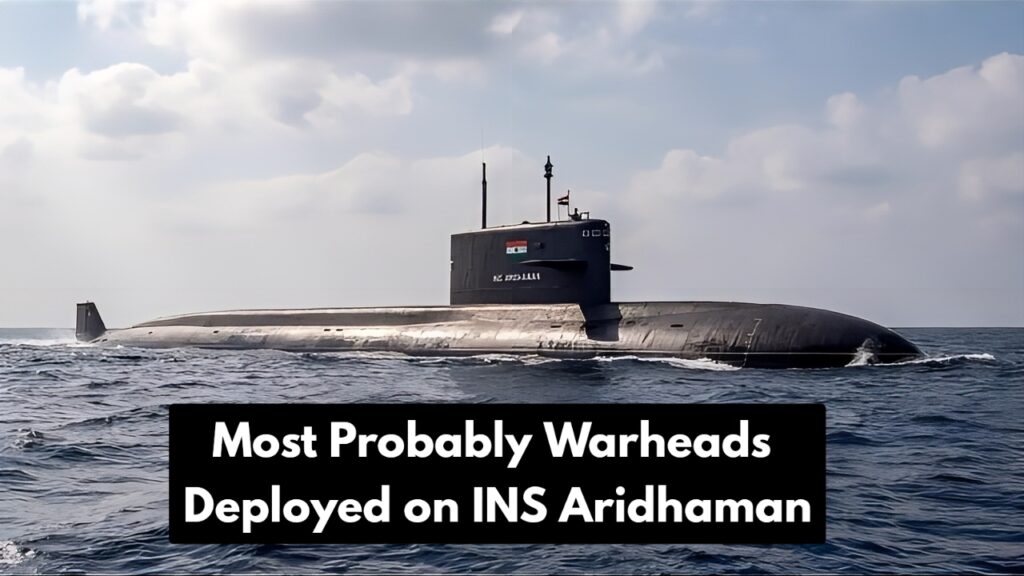
Some reports also mention INS Aridaman, but it is not yet confirmed to be on operational patrol. Therefore, most analysts believe the 12 warheads are likely deployed on either INS Arihant or INS Arighaat, with a slight preference toward a single submarine on patrol.
Why 12 warheads ?
The number itself provides an important clue.
An Arihant-class SSBN can carry:
• Up to 12 K-15 (Sagarika) submarine-launched ballistic missiles, or
• 4 K-4 SLBMs carrying multiple warheads depending on configuration.
Because SIPRI specifically estimates 12 deployed warheads, many defence observers speculate that this could correspond to a submarine carrying a load of 12 K-15 missiles with single warheads, although this remains an educated assessment rather than confirmed fact.
Disclaimer :
While New Delhi has not officially commented on SIPRI’s findings, the report is likely to fuel fresh debates about deterrence, stability and the future of nuclear strategy in South Asia.