Recent assessments from early 2026 indicate a significant shift in global naval power under the sea. China has overtaken Russia to become the world’s second-largest operator of nuclear-powered submarines, trailing only the United States. This milestone highlights China’s rapid naval modernization and massive shipbuilding capacity, allowing it to expand its undersea force at an unprecedented pace.
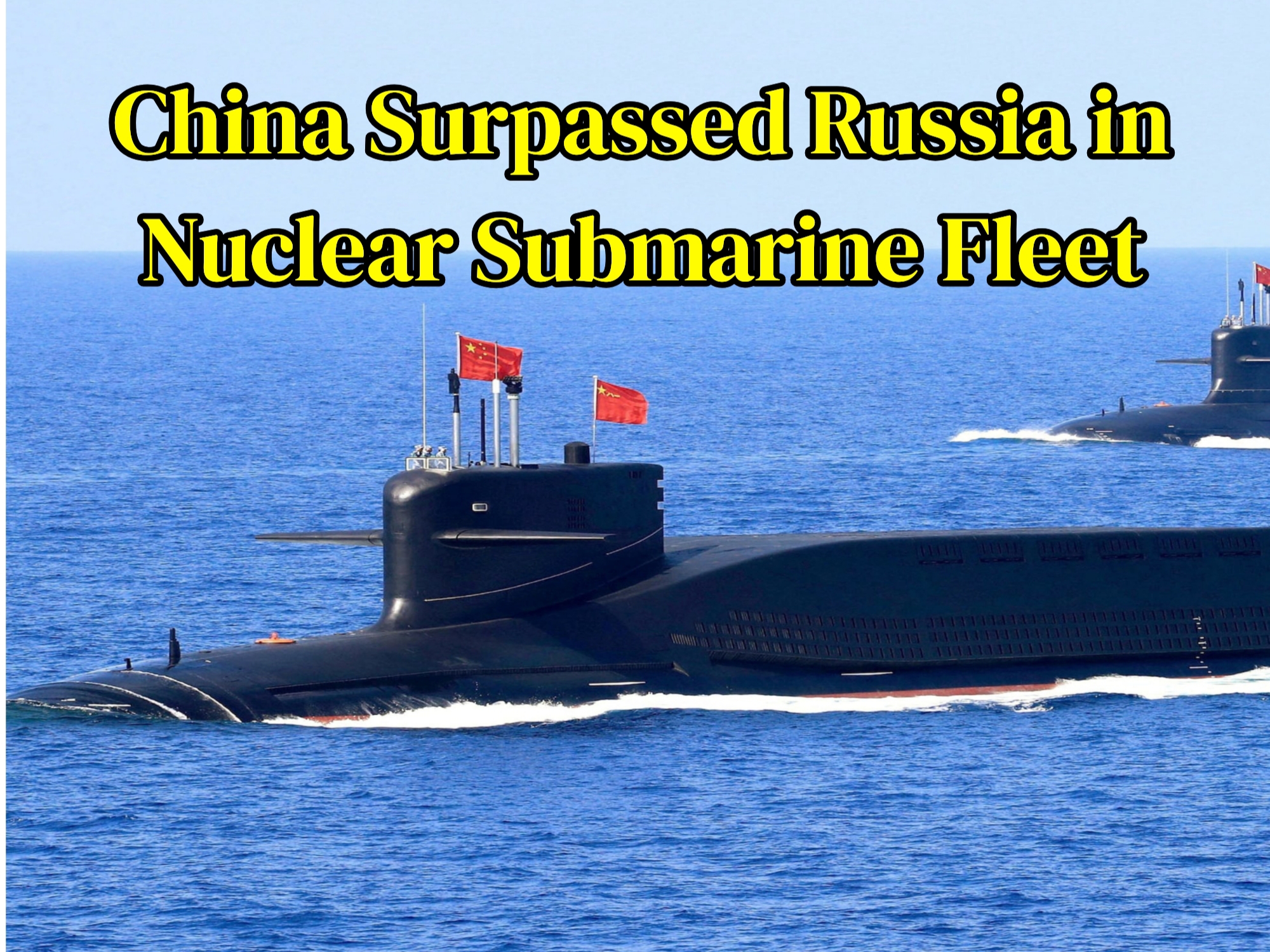
According to multiple defense analyses published in January 2026, China now fields an estimated 32 active nuclear submarines. This includes a mix of attack submarines (SSNs), guided-missile submarines (SSGNs), and ballistic missile submarines (SSBNs). The fleet features nine Type 093/093A Shang-class nuclear-powered attack submarines as its core, supported by the Type 094 Jin-class ballistic missile submarines and emerging newer variants like the Type 093B.
For comparison, Russia’s fleet is assessed at approximately 25–28 operational nuclear-powered submarines, including advanced Borei-class SSBNs and Yasen/Yasen-M SSGNs, along with some older platforms. While Russia maintains technological edges in certain areas (such as strategic deterrence systems), China’s numerical advantage marks the first time it has pulled ahead in total active hulls.
Types Submarines in the Fleet
China’s nuclear submarine fleet breaks down into the following main categories :
SSBNs (Nuclear-Powered Ballistic Missile Submarines) :
These form China’s sea-based nuclear deterrent, carrying submarine-launched ballistic missiles (primarily JL-2 and upgraded JL-3 variants).
• Type 094/094A Jin-class : Approximately 9 in service.
This represents a significant increase from earlier estimates (e.g., 6 in 2025 assessments), reflecting accelerated commissioning and improvements for better stealth and missile range. Each can carry up to 12 missiles, enabling credible at-sea deterrence patrols.
SSNs (Nuclear-Powered Attack Submarines) :
These multi-role boats focus on anti-submarine warfare, anti-surface strikes, intelligence gathering, and carrier escort.
• Type 093/093A Shang-class (basic and improved variants) : Approximately 9 in service.
These form the core of the deployed SSN fleet, with ongoing enhancements for better sensors and quieting.
The newer Type 093B (sometimes classified as SSGN due to vertical launch systems for cruise missiles like YJ-18 anti-ship and land-attack variants) has seen rapid production, with 7–8 units launched or commissioned between 2022 and early 2026. These add significant strike capability, blurring the line between traditional SSN and SSGN roles.
SSGNs (Nuclear-Powered Guided-Missile Submarines) :
China does not maintain a separate dedicated SSGN class like the U.S. Ohio-class conversions. Instead, the Type 093B variant functions in an SSGN-like role with vertical launch tubes for heavy cruise missile loads, enhancing land-attack and anti-ship options beyond standard torpedo tubes.
• Effective SSGN capability : Approximately 14 (not all fully active) Primarily through the growing Type 093B fleet (part of the broader Shang-class family), with estimates of several operational by 2026.
So as of January 2026, China’s People’s Liberation Army Navy (PLAN) operates an estimated 32 active nuclear-powered submarines in total (second-largest globally, surpassing Russia).
Total Number of Nuclear Submarines of US , China & Russia
As of January 2026, the three leading nuclear-powered submarine fleets globally are those of the United States, China, and Russia, with the U.S. maintaining the largest and most advanced force.
1. United States (U.S. Navy) : Approximately 71 active nuclear submarines in total, including ~53 SSNs (fast-attack submarines like Virginia, Seawolf, and Los Angeles classes for multi-mission roles such as anti-submarine warfare and strike), 14 SSBNs (Ohio-class ballistic missile submarines providing the sea-based nuclear deterrent with Trident II SLBMs), and 4 SSGNs (converted Ohio-class guided-missile submarines optimized for Tomahawk cruise missiles and special operations support). This positions the U.S. as the dominant undersea power, though production challenges have slowed growth.
2. China (People’s Liberation Army Navy – PLAN) : An estimated 32 active nuclear-powered submarines, marking a rapid ascent to second place globally (surpassing Russia). This includes ~9 Type 094/094A Jin-class SSBNs (for sea-based nuclear deterrence with JL-2/JL-3 SLBMs), ~9 Type 093/093A Shang-class SSNs (multi-role attack boats), and a growing number of Type 093B variants functioning in an SSGN-like role with vertical launch systems for cruise missiles (contributing to the overall 32 hulls , excluding next-gen Type 095 SSN and Type 096 SSBN under early construction).
3. Russia (Russian Navy) : Between 25 to 28 active nuclear-powered submarines, now ranking third. This comprises ~10–12 SSBNs (primarily Borei-class and older Delta IV for strategic ballistic missile deterrence with Bulava and other SLBMs), plus Yasen/Yasen-M class SSGNs/SSNs and legacy attack platforms. Russia maintains a strong qualitative edge in some areas but faces slower replacement of aging hulls.
These estimates reflect open-source assessments from early 2026 reports, accounting for recent commissions, retirements, and ongoing production at shipyards like U.S. (Newport News/Electric Boat), China’s Huludao, and Russia’s Sevmash. Exact figures vary slightly due to classification and operational status, but the U.S. leads decisively in quantity and technological maturity, while China’s buildup emphasizes rapid numerical growth for Indo-Pacific projection, and Russia’s focuses on sustaining strategic deterrence amid modernization efforts.
Where INDIA exist in this Race ?
As of January 2026, India has 2 operational nuclear-powered submarines, both of the Arihant-class ballistic missile submarines (SSBNs) :
• INS Arihant : Commissioned in 2016 and fully operational, conducting deterrent patrols.
• INS Arighaat : Commissioned in August 2024 and operational.
These are the only indigenously built nuclear-powered submarines currently in active service with the Indian Navy. India does not yet operate any nuclear-powered attack submarines (SSNs) indigenously, though it has previously leased Russian Akula-class SSNs (e.g., INS Chakra II, returned in 2021), and a new lease is expected around 2025–2028.
Upcoming Developments in the Arihant Class
India’s Arihant-class program aims for a total of 4 submarines (with some reports mentioning a potential fifth):
• Third submarine (INS Aridhaman / S-4) : Sea trials completed recently (as of late 2025), expected to be commissioned in early 2026.
• Fourth submarine (S-4, likely named INS Arisudan) : Launched in 2024, sea trials ongoing (started late 2025), expected commissioning in early 2027.
This means India currently has 4 Arihant-class SSBNs at various stages (2 operational + 2 in trials/construction), but the total operational nuclear submarines remain 2 right now.
Future Plans
• S5-class SSBNs — Next-generation larger submarines (around 13,500 tonnes) ; construction of the first units has begun, with entry into service expected in the early 2030s (total of 4 planned).
• Project 77 SSNs — Indigenous nuclear attack submarines ; construction of the first two approved, but none operational yet (first expected around 2036–2039).
A Bitter Truth
INDIAN Navy currently operates approximately 18 Submarines (including 2 SSBN) in total but most of them conventional Submarines going to retire , A new submarines manufacturing is too slow. And India have less experience in submarine development, lack of budget and infrastructures. Sadly India can never Equal of US, China & Russia in Submarines Fleet. ,
Even Pakistan has few advantage in their Submarine fleet because Pakistan has 3 Operational AIP Equipped Submarine and INDIA has no any AIP Equipped Operational Submarine.