The Surya missile (Sanskrit for “Sun”) has long been a subject of intrigue in defense circles, often described as India’s potential ultra-long-range intercontinental ballistic missile (ICBM). First mentioned in a 1995 report by The Nonproliferation Review, it has been speculated as a highly ambitious project under the Defence Research and Development Organisation (DRDO). Over the decades, media reports, think tanks, and international analysts have linked it to India’s strategic missile ambitions, particularly for achieving mutually assured destruction (MAD) capabilities against distant threats.
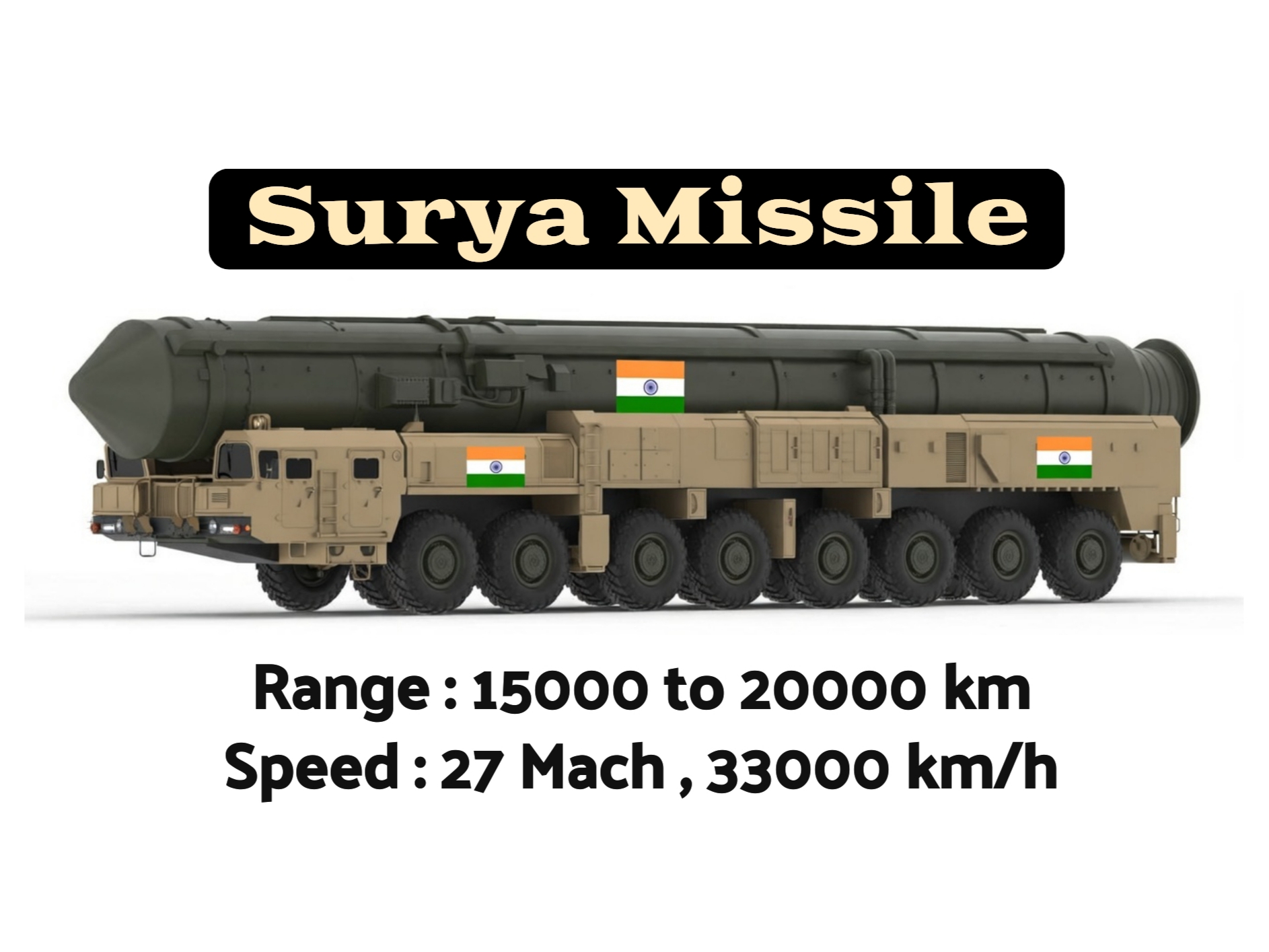
However, despite persistent rumors and exaggerated claims in some online discussions and articles, the Surya remains unconfirmed by official Indian sources. India’s current focus in strategic deterrence centers on the proven Agni series, with the Agni-V serving as its longest-range operational missile. Recent developments in 2025–2026 highlight DRDO’s advancements in related technologies, but no official project named “Surya” exists in public domain announcements.
Missile Specifications : Speculative Claims
Speculations about the Surya missile vary widely across sources, often portraying it as a next-generation ICBM with extraordinary capabilities. Common claimed details are :
• Range : 12,000 to 18,000+ km (some extreme claims suggest up to 20,000 km, theoretically covering the entire globe).
• Speed : Hypersonic level , potentially reaching Mach 27 (around 33000 km/h during re-entry phase).
• Payload : 3 to 5 tonnes, capable of carrying multiple independently targetable re-entry vehicles (MIRVs) or maneuverable warheads (MaRVs), with nuclear yields from hundreds of kilotons to megatons ; some reports mention 5 to 15 thermonuclear warheads.
Official Stance
The Government of India and DRDO have never officially acknowledged or confirmed a missile program named Surya. There are no formal statements, test announcements, or inclusions in official defense reports/websites (drdo.gov.in) as of 2026. Indian officials, including former DRDO chiefs, have repeatedly stated that missile ranges beyond current needs (like Agni-V covering all of China) are a “political call” rather than an immediate priority.
India’s strategic doctrine adheres to credible minimum deterrence and no-first-use policy. Recent official successes include MIRV tests on Agni-V (March 2024), long-range hypersonic missile trials (2024–2025), and scramjet engine advancements (January 2026)—but none reference Surya.
In summary, while India possesses the technological base for longer-range ICBMs (via Agni-VI concepts), the “Surya” appears to be more myth than reality, fueled by speculation rather than substance. India’s defense advancements remain focused on proven, regionally relevant systems for national security.
Can INDIA Build This ?
Technically Yes : India can build missiles like the speculated Surya (10,000–18,000 km class) today, leveraging decades of indigenous development. However, whether it chooses to deploy them depends on strategic needs, evolving threats (e.g., China’s expanding arsenal), and international considerations rather than any lack of capability.
India’s missile program continues to advance rapidly, with focus on hypersonics, heavier payloads, and second-strike options — ensuring it remains a credible nuclear power.