India unveils its first indigenous Vikram 32-bit processor at Semicon India 2025, a major milestone in the Indian Semiconductor Mission. Fabricated at 180nm by ISRO’s SCL, this Made in India chip targets automotive, IoT, and defense applications, signaling India’s rise as a global semiconductor hub.

In a landmark moment for India’s technological advancement, Prime Minister Narendra Modi was presented with the nation’s first fully indigenous semiconductor chip, named the Vikram 32-bit processor, during the inauguration of Semicon India 2025 on September 2, 2025. The event, held at Yashobhoomi in New Delhi, underscores India’s ambitious push to become a global semiconductor powerhouse. Union Minister for Electronics and Information Technology, Ashwini Vaishnaw, handed over the chip to PM Modi, highlighting it as a symbol of India’s self-reliance in critical technology sectors. This presentation marks a historic milestone, as the chip was developed entirely within India by the Indian Space Research Organisation’s (ISRO) Semiconductor Laboratory (SCL), demonstrating the country’s capability to design and fabricate advanced microprocessors for demanding applications.
Semicon India 2025, jointly organized by the India Semiconductor Mission (ISM) and SEMI, runs from September 2 to 4, 2025, and brings together global industry leaders, innovators, and policymakers to discuss the future of semiconductors. PM Modi, in his address, emphasized India’s late but unstoppable entry into the semiconductor arena, stating, “Designed & made in India, trusted by the world.” He highlighted the government’s commitment through the ₹76,000 crore India Semiconductor Mission, launched in 2022, which aims to build a robust domestic ecosystem for chip design, manufacturing, and packaging. The event also showcased India’s progress, with five semiconductor fabrication units under construction and investments pouring in from international giants like Nvidia, AMD, and Micron Technology.
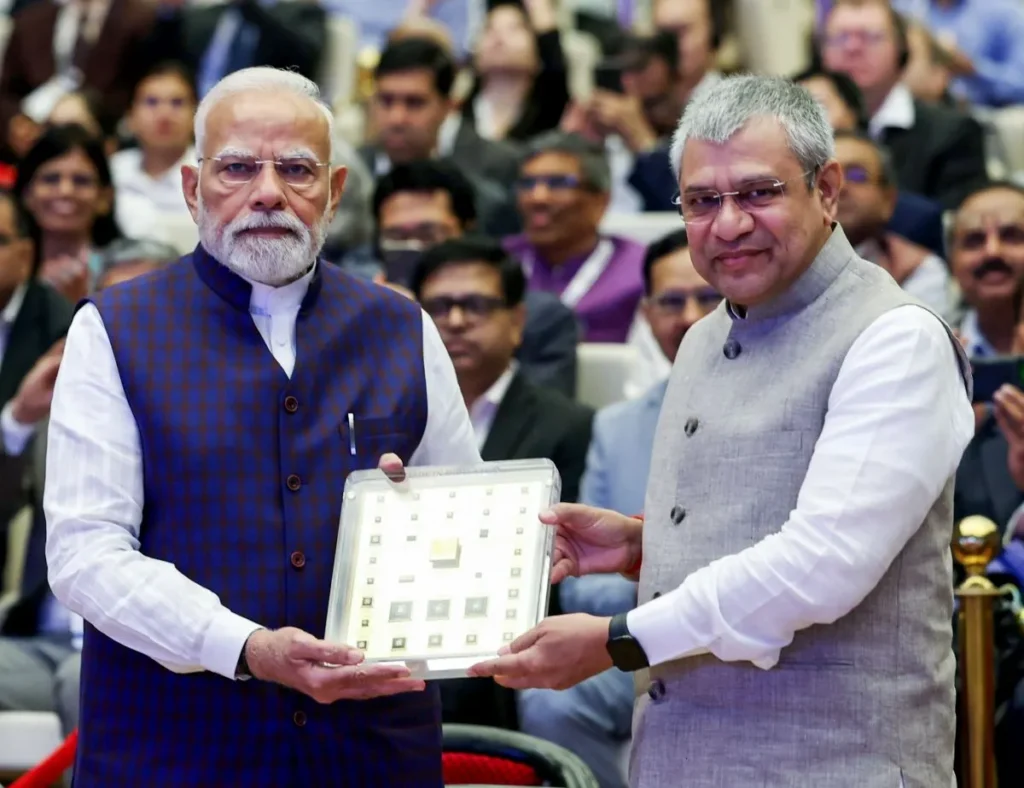
Industry leaders hailed the achievement, noting that India is positioning itself as a key player in the global semiconductor supply chain. The Vikram chip’s unveiling comes amid growing geopolitical tensions and supply chain disruptions, making self-reliance in semiconductors a strategic imperative. Minister Vaishnaw described the moment as a “proud achievement,” pointing out that the chip is ready for commercial rollout, initially planned for December 2024 but now accelerated to September or October 2025. This development aligns with broader initiatives, including the Design-Linked Incentive (DLI) scheme, which has approved 23 chip design projects supporting startups like Vervesemi Microelectronics for applications in defense, aerospace, and electric vehicles.
Specifications of the Vikram Processor :
The Vikram 32-bit processor, also referred to as VIKRAM3201, is a 32-bit microprocessor fabricated using a 180nm process node, making it suitable for high-volume, cost-effective applications that require reliability in harsh environments. Developed by ISRO’s SCL in Chandigarh, this chip has been qualified for use in space applications, including launch vehicles, where it must withstand extreme conditions such as radiation, vibration, and temperature fluctuations. The 180nm node targets a significant portion of the global semiconductor market—around 60%—focusing on mid-range demands rather than the ultra-advanced sub-10nm nodes used in high-end computing.
Key technical details include its 32-bit architecture, which supports efficient processing for embedded systems. While exact specifications like clock speed, transistor count, and power efficiency have not been fully disclosed, sources indicate it operates effectively in the 28-90nm range for broader applications, though the Vikram specifically leverages 180nm for robustness. This makes it ideal for automotive sectors, such as electric vehicles (EVs), consumer electronics, Internet of Things (IoT) devices, telecommunications, railways, and potentially defense systems. The chip’s design emphasizes durability, with ISRO’s expertise ensuring it meets stringent standards for mission-critical operations.
In addition to the Vikram, the event featured other indigenous chips, including test chips from four approved projects under the ISM. For instance, Assam showcased the Tata OSAT Chip and NIT Silchar’s Neural Amplifier Frontend IC, reflecting regional contributions to the national effort. CG-Semi, a domestic manufacturer, is set to produce chips using a 28nm process at a pilot facility, with commercial production ramping up to 48 million units daily through collaborations like Tata Electronics and Taiwan’s Powerchip Semiconductor Manufacturing Corp in Dholera, Gujarat—a ₹27,000 crore investment. Micron’s assembly and test facility in Sanand, Gujarat, is 60% complete, while a UK-based firm plans a ₹300 billion fab in Odisha.
These details highlight a multi-faceted approach: the Vikram focuses on space and defense, while upcoming fabs target commercial markets. The processor’s architecture is general-purpose, allowing integration into various systems without the need for cutting-edge miniaturization, thus reducing costs and dependency on foreign suppliers.
Future Outlook for India’s Semiconductor Industry :
The unveiling of the Vikram chip at Semicon India 2025 signals India’s intent to reduce reliance on imported semiconductors, which currently account for a significant portion of its electronics needs. With global demand surging due to AI, EVs, and 5G, India’s entry could disrupt supply chains dominated by Taiwan, South Korea, and the US. PM Modi noted that despite starting late, India’s large talent pool—home to 20% of global semiconductor design engineers—and policy support position it to become one of the top five producers within five years.
This achievement is part of a larger ecosystem buildout. The ISM has attracted investments totaling over ₹1.6 lakh crore across 10 projects, including advanced packaging and fabrication facilities. Collaborations with international firms are accelerating technology transfer, while domestic startups are innovating in areas like 2D materials for next-generation chips. Social media buzz on X reflects national pride, with users praising the “Made in Bharat” initiative and its potential to boost employment and exports. For example, posts highlighted the chip’s role in commercial production, with one user noting, “India will now start its own commercial semiconductor production.”
Looking ahead, challenges remain, such as scaling up to sub-7nm nodes and securing raw materials like critical minerals. However, PM Modi’s vision of India as a “lighthouse of stability” in global tech resonates, with the event drawing participation from over 250 exhibitors and 800 delegates. The DLI scheme continues to foster innovation, supporting projects in AI, IoT, and EVs. As Minister Vaishnaw stated, four semicon units are progressing rapidly, paving the way for a resilient supply chain.
This development not only strengthens national security by indigenizing defense electronics but also boosts economic growth. With projections of the global semiconductor market reaching $1 trillion by 2030, India’s strides could capture a substantial share, creating millions of jobs and fostering startups. The Vikram chip, therefore, is more than a technological feat—it’s a cornerstone of Viksit Bharat (Developed India), symbolizing innovation, resilience, and global trust. As India accelerates its semiconductor journey, the world watches closely, recognizing its potential to reshape the tech landscape.